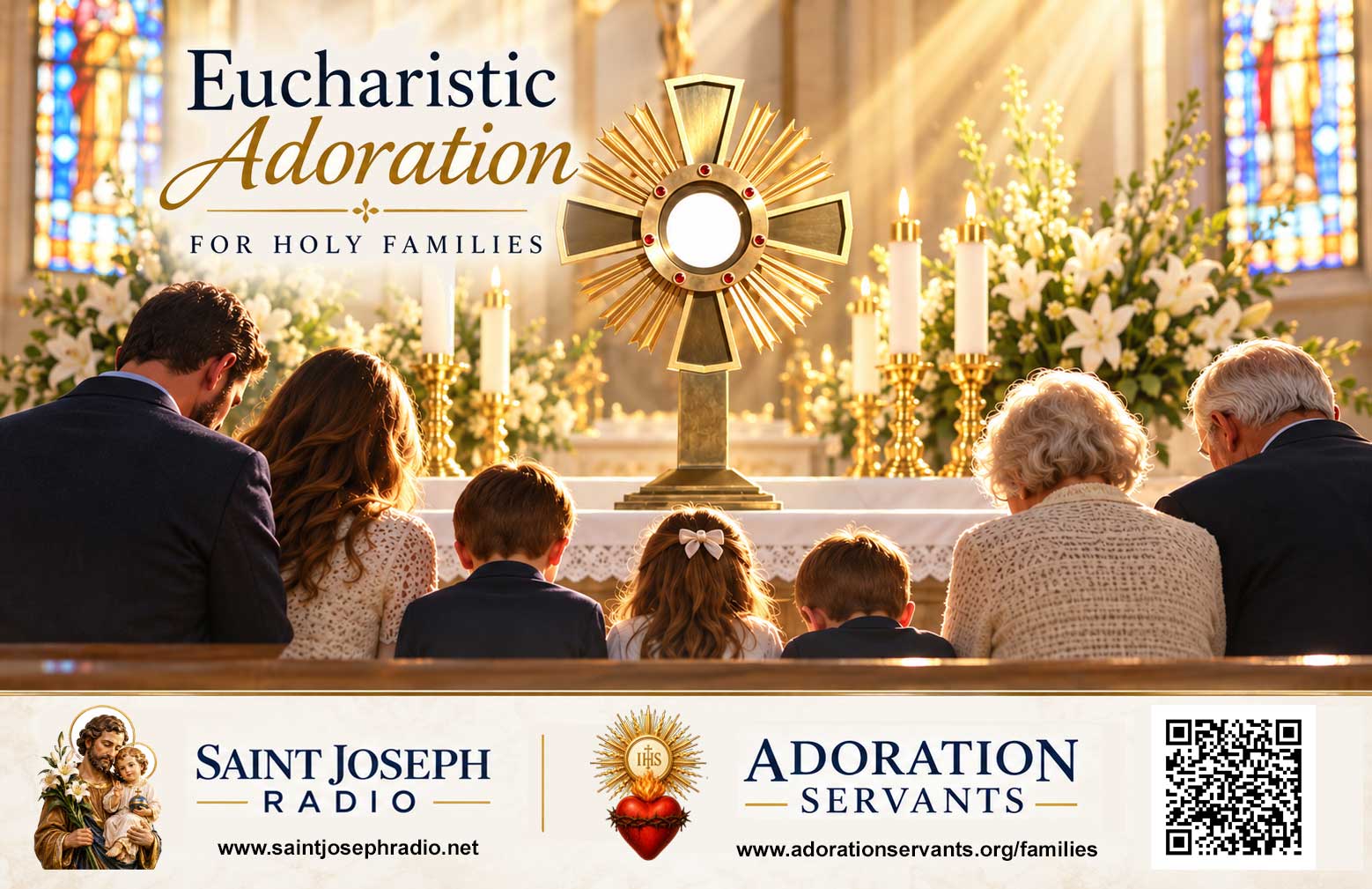
- The Family is Under Attack.
For more than a century, powerful ideological, political, and cultural movements have challenged the foundations of marriage and family life. From communism and the sexual revolution to modern secularism and moral relativism, these influences have weakened the sacred bonds of marriage, diminished the dignity of motherhood and fatherhood, and threatened the spiritual and moral formation of children.
- The Holy Familiy is Our Model.
Jesus, Mary, and Joseph reveal God's divine plan for marriage, parenthood, and family life through their example of faith, fidelity, sacrifice, and self-giving love. As Mary Shivanandan explains in The Holy Family: Model, Not Exception, the holiness of Nazareth is not an unattainable ideal but a model of communion with God that every Christian family is called to embrace.
- Eucharistic Adoration is Our Response.
The restoration of the family begins by placing Jesus Christ at the center of our homes and our lives. Through Eucharistic Adoration, prayer, retreats, and spiritual formation, we invite families, parishes, and dioceses to encounter Christ in the Blessed Sacrament, where His love strengthens marriages, renews families, and restores the communion that our world so desperately needs.
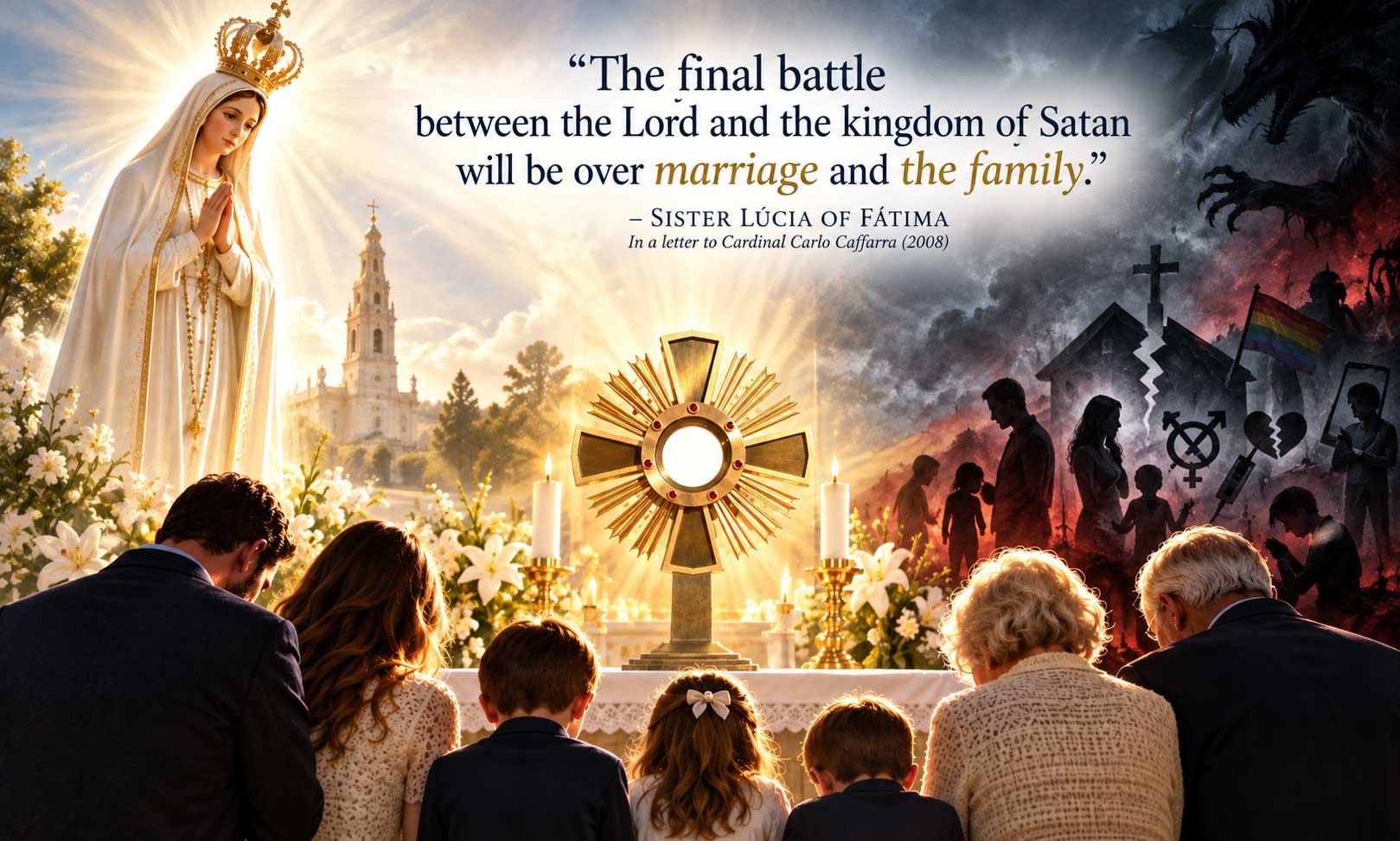
Our Lady of Fatima and the Final Battle for the Family
On July 13, 1917, Our Lady of Fatima warned that Russia would “spread her errors throughout the world, causing wars and persecutions of the Church.” Her final public apparition occurred on October 13, culminating in the Miracle of the Sun. Just 25 days after the final apparition, on November 7, 1917, the Bolshevik Revolution brought communism to power in Russia.
The attack upon traditional marriage and family life was no accident. Marx and Engels had already challenged the bourgeois family in The Communist Manifesto of 1848. In his 1948 book Communism and the Conscience of the West, Blessed Fulton Sheen documented how Soviet communism undermined marriage, parental authority, and religious life, while warning that the family was equally essential to America's future.
As historian Paul Kengor documents in Takedown, the revolutionary assault on traditional marriage and family life that began with the rise of communism in 1917 continued throughout the twentieth century, gaining increasing influence in Western academia and spreading through education, politics, and popular culture.
Decades after Fatima, Cardinal Carlo Caffarra revealed Sister Lucia's warning that the decisive battle between Christ and Satan would concern marriage and the family. Yet Fatima remains a message of hope, calling us to prayer, conversion, and confidence in Our Lady's promise: “In the end, my Immaculate Heart will triumph.”

Satanic Separation — The Family Under Attack Today
Since 2008, challenges to traditional marriage, family life, and Christian moral principles have accelerated dramatically throughout Western society. Many of the profound changes in marriage, sexuality, and family structures anticipated by futurist Alvin Toffler in his 1970 book Future Shock have become realities. What once seemed like distant predictions have unfolded with remarkable speed, particularly through the influence of academia, mass media, and modern technology.
The battle for marriage and family life is not confined to history books or distant political movements. It is taking place in our homes, schools, communities, and increasingly in the private lives of every family member. Modern society offers unprecedented opportunities for communication, entertainment, and personal freedom, yet families often find themselves more isolated, divided, and spiritually disconnected than ever before.
The dangers are not always obvious. They emerge when faith is pushed to the margins of daily life, when marriage loses its sacred character, when motherhood and fatherhood are diminished, when children are deprived of moral and spiritual formation, and when technology and cultural influences replace the personal relationships upon which family life depends.
These five SEPARAITOINS are not unrelated problems. They are different expressions of the same fundamental separation: the separation of the human person and the family from God. The consequences reach beyond individual households, weakening the bonds of love, responsibility, sacrifice, and fidelity that sustain both the Church and society.
Yet the Christian family is not powerless against these influences. Its greatest strength is found not in withdrawing from the world, but in restoring Jesus Christ to the center of family life.
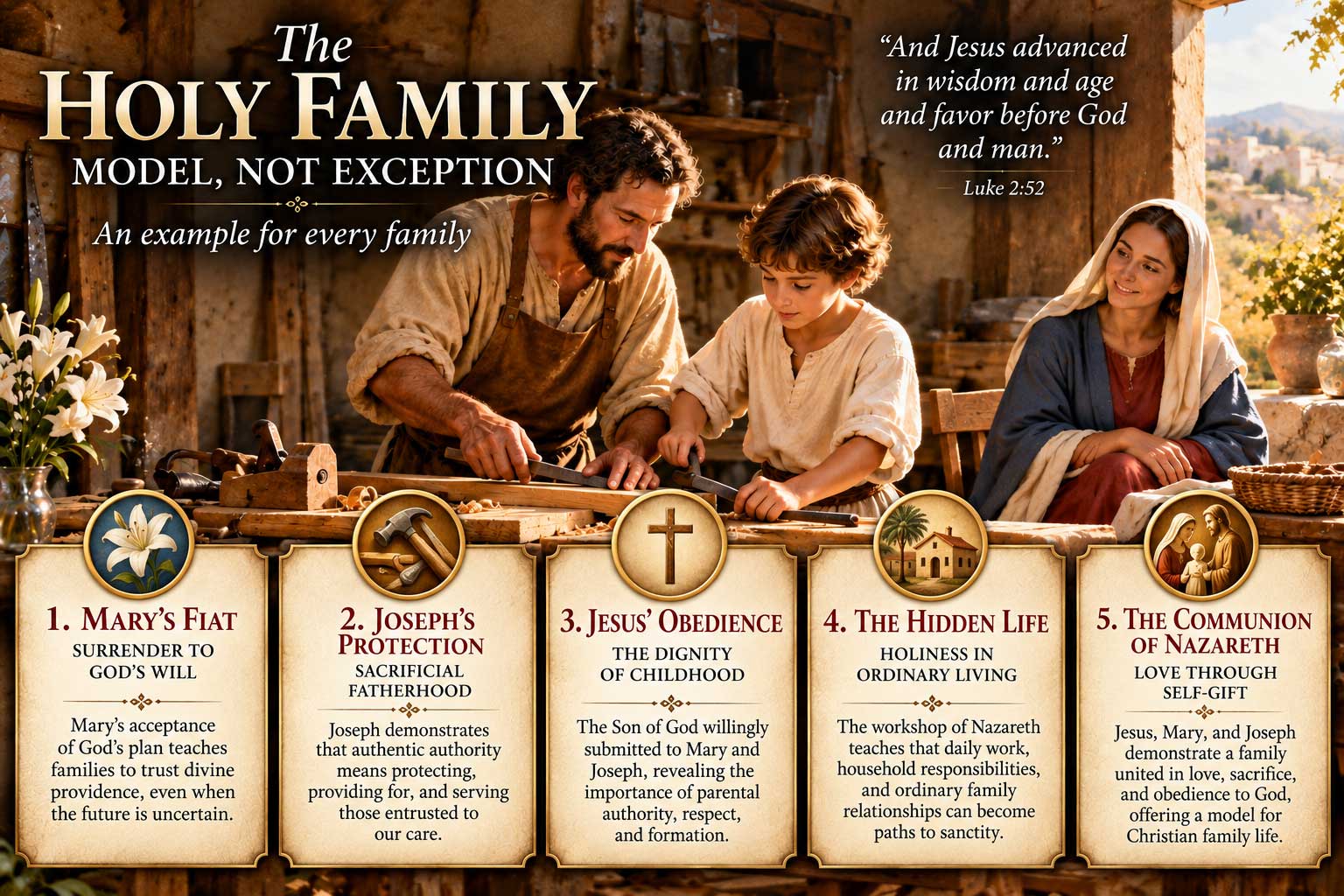
The Holy Family — Model, Not Exception
In a world where marriage and family life are increasingly challenged, God has given us the Holy Family of Nazareth as the perfect model of love, holiness, and communion. Yet many Christians regard Jesus, Mary, and Joseph as so extraordinary that their lives seem impossible to imitate. In her book The Holy Family: Model, Not Exception, Catholic theologian Mary Shivanandan challenges this misconception, revealing that the Holy Family offers a living example for every Christian household.
At the heart of her teaching is the understanding of the family as a communion of persons, united not merely by blood or shared responsibilities, but through mutual love, sacrifice, and the complete gift of self. The Holy Family reveals that authentic love is rooted in God and expressed through the ordinary circumstances of daily life. Holiness is not reserved for monasteries or extraordinary individuals; it is a calling shared by husbands, wives, parents, and children.
This understanding also illuminates the deeper meaning of Humanae Vitae. Far more than a teaching about contraception, the encyclical affirms the sacred union of husband and wife, the inseparable relationship between marital love and openness to life, and the dignity of marriage as a vocation of self-giving love.
The Holy Family is not simply an example to admire, but a model to embrace. Through prayer, the sacraments, and especially Eucharistic Adoration, families can draw upon the grace necessary to restore their communion with God and one another, becoming what the Church calls them to be: domestic churches, sanctuaries of love, and witnesses to Christ in the world.
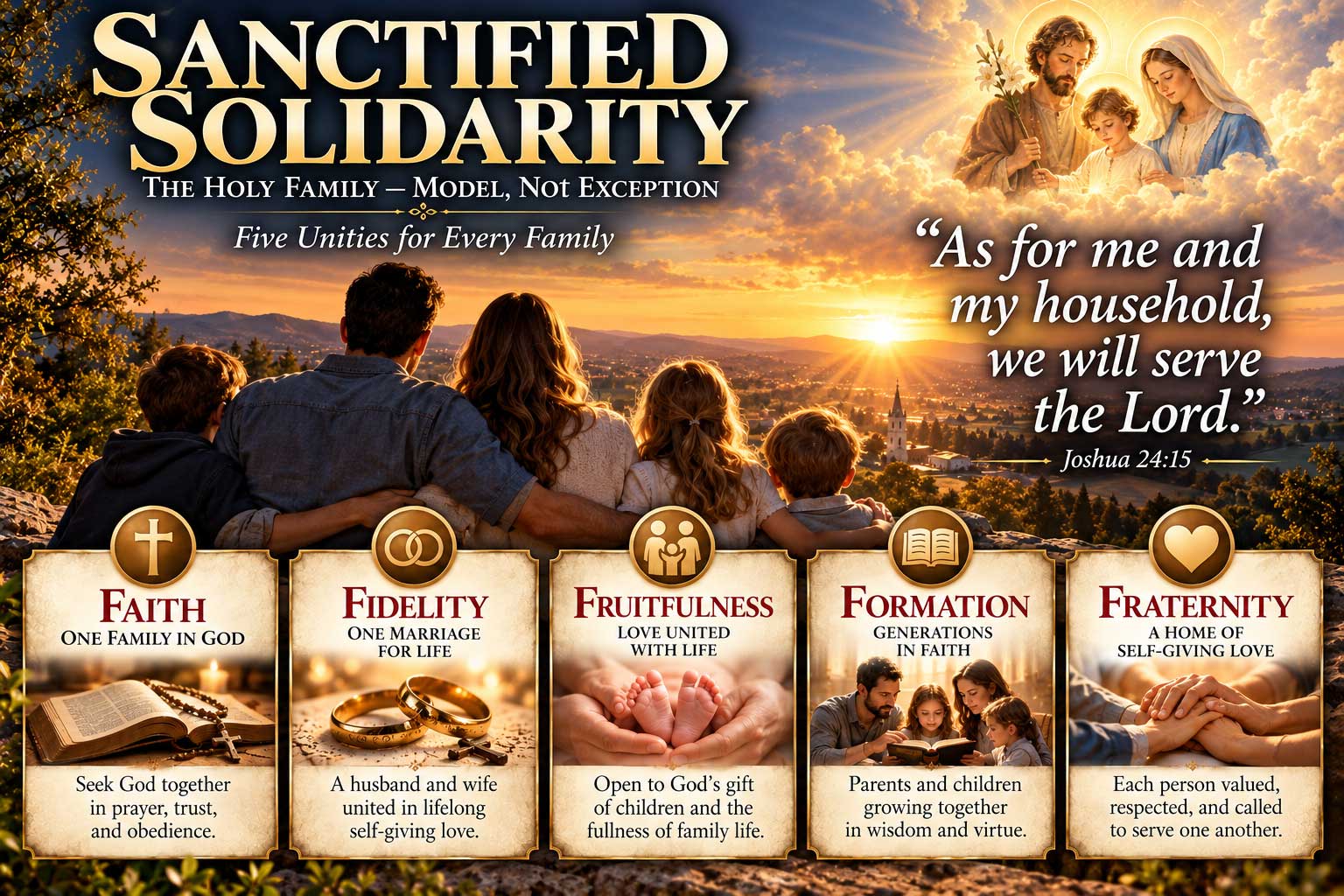
Sanctified Solidarity — Families United in Christ
The restoration of Christian family life cannot be accomplished by individual households struggling in isolation. Just as the Holy Family of Nazareth lived in communion with God and one another, Christian families are called to a greater communion that extends beyond their own homes, embracing their parishes, communities, and the universal Church.
The family is the domestic church, the first school of love, faith, sacrifice, and holiness. It is where children first encounter God, where parents discover the sacred responsibilities of their vocation, and where generations learn to care for one another. Yet families also need the friendship, encouragement, and spiritual support of other families who share their commitment to Christ.
This is the meaning of Sanctified Solidarity: families strengthening families through a common life of faith. It is more than social fellowship or shared moral convictions. It is a spiritual communion in which families pray for one another, defend the dignity of marriage and parenthood, support those facing difficulties, and help one another persevere in holiness.
As Saint John Paul II taught, the family is called to become a community of life and love, participating in the mission of the Church and contributing to the renewal of society. When families unite around Jesus Christ, their witness becomes greater than the sum of their individual efforts. What begins in the home can transform the parish, strengthen the Church, and bring hope to a world increasingly divided and isolated.
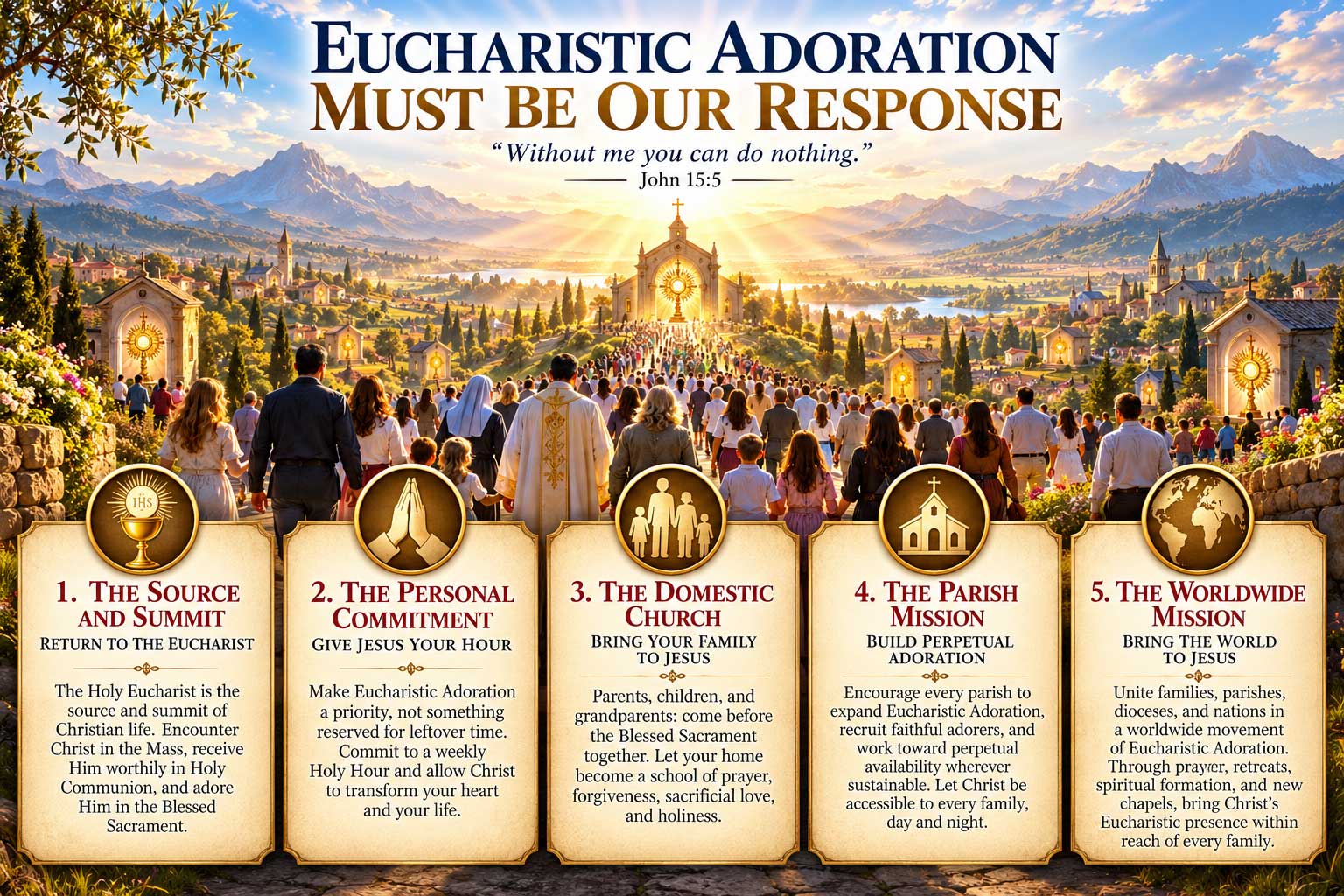
Eucharistic Adoration Must Be Our Response
The restoration of marriage, family life, and Christian civilization cannot be accomplished through political movements, educational reforms, or cultural initiatives alone. These efforts may have their place, but lasting renewal must begin with a personal encounter with Jesus Christ. As He reminds us in the Gospel of John, “Without me you can do nothing” (John 15:5).
In the Holy Eucharist, Christ does not merely offer us an example to follow or a teaching to embrace. He gives us Himself. Through the Holy Sacrifice of the Mass, Holy Communion, and Eucharistic Adoration, we encounter the source of divine love that makes authentic communion possible. Before the Blessed Sacrament, husbands and wives rediscover the meaning of self-giving love, parents find strength for their sacred responsibilities, and children learn that Jesus is not a distant figure of history but a living presence in their lives.
The transformation of society begins with the transformation of souls. One person, one marriage, one family, and one parish at a time, Eucharistic Adoration can become a powerful instrument of spiritual renewal., but it must truly be made a priority. A publicly declared priority. A mission that is not pushed aside or practiced only when convenient.. What begins with a single Holy Hour can grow into a lifelong commitment, inspiring families to pray together, parishes to establish Perpetual Adoration, and communities to place Christ at the center of their lives.
Our mission is not merely to defend the family against the forces that threaten it, but to help families become what God created them to be: communities of love, holiness, and communion with Him. We invite every Catholic family to make Eucharistic Adoration a priority, joining a growing movement of prayer that can renew the Church and transform the world.
The battle for the family is ultimately a battle for souls. Our greatest strength is Jesus Christ, truly present in the Eucharist.
